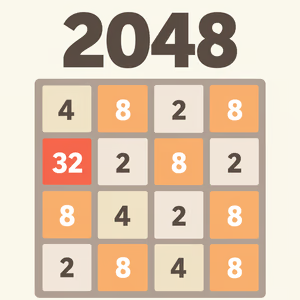
2048
 Bunny Farm
 Longcat
 Mahjong Connect
 Helix Jump
 Bad Ice-Cream
 Stealing the Diamond
 Blocky Blast Puzzle
 Block Breaker
 Brick Breaker
 Block Blast Puzzle
 Color Block Jam
 Block Blaster
 Tetris
 Hexa Stack
 Big Block Blast
 Paper Block
 BlockBuster Puzzle
 Blocky Rush
 Xmas Block Blast
 Blox Puzzle
 Blox Slider
 Idle Breakout
 Hexa Puzzle
 Wood Block Journey
 Neon Block Blast
 Sandtris
 Cubes 2048
 Tomb of the Mask
 Candy Crush
 Bloxorz
 block Jam
 Tetra Twist
 Bubble Shooter
 Tic Tac Toe
 Water Sort Puzzle
 Bricky Blast
 Solitaire
 Suika Game
 Parking Rush
 Free The Key
 Level Devil
 Apple Worm
 Her Trees
 Uno Online
 Happy Glass
 Block Quest
 Bus Stop Jam
 Block Blast Jewel Puzzle
 Spider Solitaire
The Inspiration Behind the Creation of 2048
2048 was developed around the idea of merging numbered tiles to create larger values, drawing inspiration from earlier puzzle games. 1024 by Veewo Studio had a direct influence on its number-merging mechanics and the way players interact with the board. Meanwhile, Threes! by Asher Vollmer shares a similar concept, building its gameplay around combining numbered tiles according to specific rules.
Inspired by these games, 2048 features a 4x4 grid and four basic movement directions. Players slide all the tiles in a chosen direction, merging two tiles with the same value to create a new tile worth twice as much. Every move affects the positions of the other tiles, making tile arrangement and direction selection essential parts of the gameplay.
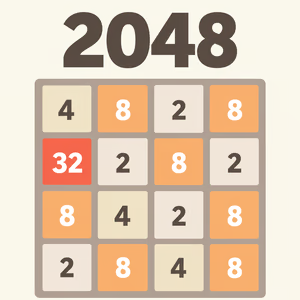
Figure 1. Play 2048 online and turn a simple grid
The Minimalist Design and Appeal of 2048
2048 uses a square board with four rows and four columns, providing 16 spaces for numbered tiles. Each tile displays a value, usually starting at 2 or 4, which increases as matching tiles merge. The tiles change colors based on their values, making it easier to distinguish between different number levels during gameplay. When two tiles with the same value merge, they form a new tile worth twice as much.
The appeal of 2048 comes from how every move can affect the entire board. A single slide can create opportunities to merge multiple tiles, but it can also separate high-value tiles or quickly fill up the grid. With no countdown timer adding pressure, players can take their time and consider each move. However, new number tiles appear after every valid move, gradually reducing the available space and requiring players to adjust their strategies.
How to Play 2048
Observe the Board
At the start, look at the numbered tiles on the 4x4 grid. Identify pairs with matching values and consider whether a move can bring them closer together. Pay attention to empty spaces as well to estimate how much room will remain after your next move.
Move the Tiles
Choose one of four directions: up, down, left, or right. All tiles slide in the selected direction until they reach the edge of the board or are blocked by another tile. Tiles with matching values merge when they meet during the movement.
If a move does not change the position or state of the board, it is invalid and will not help you progress.
Merge Tiles with Matching Values
Focus on bringing matching tiles into the same row or column to create larger values. For example, merge two 4 tiles into an 8, then combine that 8 with another 8 on a suitable move to create a 16. Each tile can merge only once per move. Therefore, check the order of the tiles before choosing a direction, especially when a row or column contains several matching numbers.
Save Space for Future Moves
As the numbers grow, the board can quickly become crowded. Avoid moves that scatter high-value tiles across the grid, and try to maintain an arrangement that is easy to control. A common strategy is to keep the largest tile in one corner and arrange smaller tiles in descending order around it.
Controls
- On PC: Use the arrow keys to move the tiles in the corresponding direction.
- On mobile: Swipe up, down, left, or right across the board to move the tiles in the chosen direction.
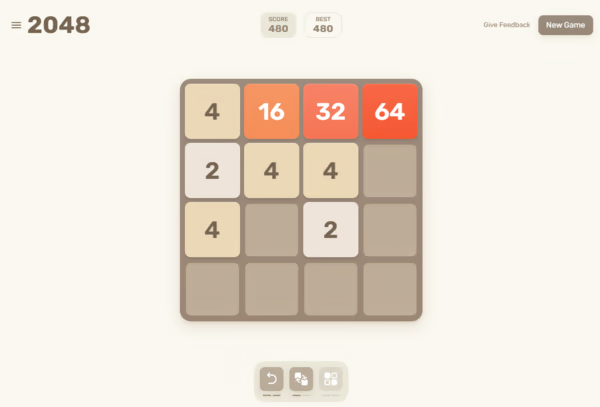
Figure 2. A clever number puzzle
What Happens After Reaching 2048?
Creating a 2048 tile is a major milestone, but it does not necessarily mean the game has to end immediately. In the classic version, players can continue merging tiles to reach higher values, such as 4096 or 8192, while working to improve their scores.
After reaching the initial goal, the challenge shifts to keeping the board playable for longer and taking advantage of the remaining merging opportunities. Higher-value tiles require more combinations to grow further, while empty spaces become increasingly difficult to preserve. This makes board management and move prediction even more important after reaching 2048.
Players can also set personal goals, such as achieving a higher score, creating the largest possible tile, or improving their performance with each attempt. As a result, 2048 continues to offer a challenge even after the main objective has been completed.
Play 2048 Online
2048 is well suited to online play thanks to its simple mechanics and controls that work with either a keyboard or touch gestures. Players can access the browser version, start a new round, and practice their strategies without installing a large game application.
Alongside 2048, blockblast3d.com offers other puzzle and block games to explore, including Block Blast, Block Blast 3D, and titles from the puzzle game category. Each game provides a different challenge, from clearing space by matching blocks to arranging shapes and planning their placement.
If you enjoy studying the board, predicting moves, and making every decision count, 2048 is a great place to start. Begin with small numbered tiles, develop your strategy with each move, and work toward the target value of 2048.